


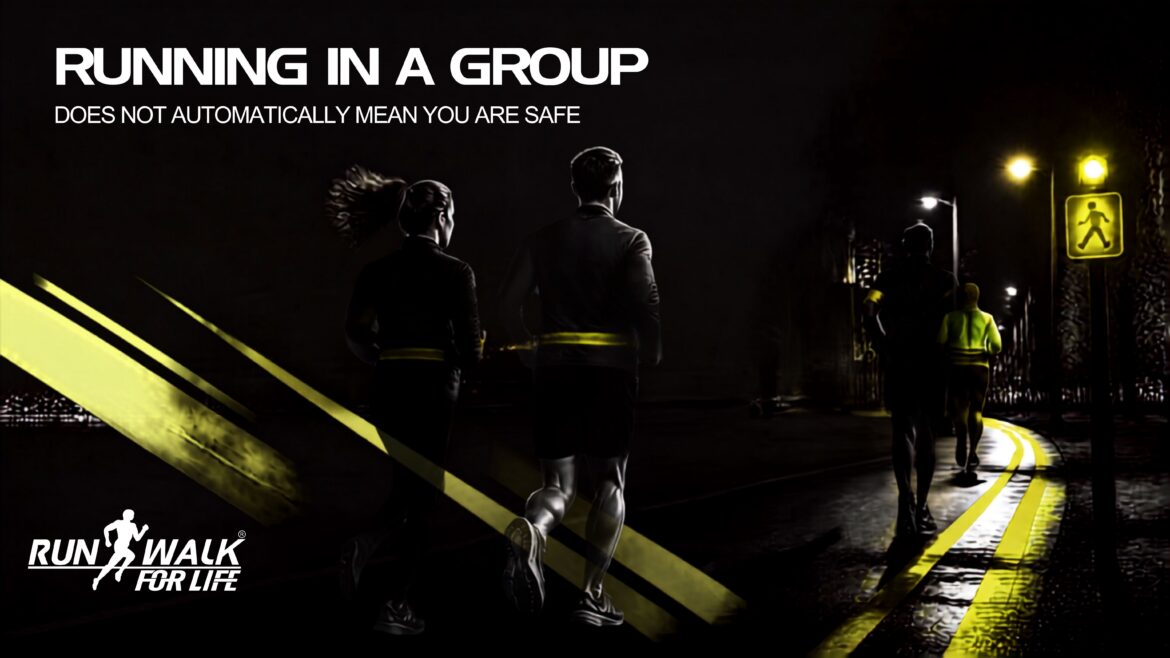
Recent events in Kempton Park (and at the MyRun in Sandton) should force South Africa’s running and walking community to have a serious conversation about what “safety” actually means.
The recent disappearance of a runner in Kempton Park, together with deeply concerning reports surrounding the discovery of women’s bodies in the area (coupled with the murder of a runner at a MyRun event in Sandton), has understandably caused fear and anger within the running community.
Our thoughts are first and foremost with the families and communities affected.
But these events also raise an uncomfortable question that those of us involved in organised exercise cannot afford to ignore:
When we tell runners and walkers that they are “safer in a group”, what are we actually doing to make that group safer?
At Run/Walk For Life, member safety has been a fundamental part of our operating model for many years, and is at the core of our offering. And our experience has taught us something important: There is a significant difference between exercising in a group and exercising within a structured safety system.
Simply putting 10, 20 or even 50 people together and sending them onto public roads does not automatically make them safe.
THE MODERN RUNNER IS NOT NECESSARILY A “LOW-VALUE” TARGET
There is a perception that runners and walkers are unattractive targets for criminals because they are exercising and therefore carrying very little of value.
Unfortunately, that assumption is increasingly questionable. Look at what many recreational runners take onto the road today:
- A premium GPS or smartwatch can be worth many thousands of rands.
- A smartphone may be worth R10,000, R20,000 or more.
- Many runners also wear wireless earphones, jewellery and other valuable equipment.
Ironically, technology that makes us feel safer or enhances our running experience can also mean that somebody exercising is carrying easily identifiable, portable and valuable items.
And exercising in a group does not remove that risk.
If a group of runners is confronted by a single armed criminal, the fact that there are six, ten or twenty runners present does not necessarily protect them.
That is why we believe running safety needs to go much further than simply saying: “Don’t run alone.”
OUR OBJECTIVE: MAKE RWFL MEMBERS UNATTRACTIVE TARGETS
At Run/Walk For Life, one of the principles behind our safety procedures is very simple:
We want a potential criminal looking at a RWFL group to see very little opportunity and very little reward.
That philosophy influences how our members exercise on the road.
We discourage valuables on the road. Members are instructed not to exercise wearing jewellery or carrying unnecessary valuables. Because we accurately measure our routes and members’ exercise times are recorded for them, there is no operational need for a member to carry an expensive GPS watch simply to know how far or how long they have exercised — we give this information to members.
We know exactly who is at every session. We have a formal logging system that records which members are exercising at every session. This means that if a member who went out does not return, we know about it — within minutes. We are not relying on somebody eventually noticing that a person is missing.
Our members exercise on predetermined, measured routes. Coaches know where members should be. We only use controlled out-and-back routes rather than simply sending members around large circular routes where people can become widely dispersed, and supervision becomes considerably more difficult.
We use Road Leaders/marshals. Our members are not simply sent out of the gate and expected to look after themselves. Road Leaders assist with supervision and monitoring while members are exercising.
We use a sweeper system. A designated person remains behind the last participants. The objective is simple but critically important: we need to know that everybody who went out has returned.
We account for every one of our members. Knowing exactly WHO started a session, which route they are doing and whether they have returned is fundamentally different from an informal group of people simply agreeing to meet and go for a run.
EVERY MEMBER IS IDENTIFIABLE
There is another important element to safety that is easily overlooked: identification.
At Run/Walk For Life, we insist that members wear official club kit when participating in our sessions.
This is not simply about branding or creating a sense of belonging.
It is part of our safety system.
A member wearing official RWFL kit is immediately identifiable as belonging to an organised exercise group. Our Coaches, Road Leaders, fellow members and, where necessary, members of the public or emergency services can recognise that person as a RWFL participant.
In an emergency, those minutes can matter.
If somebody becomes ill, is injured, becomes disorientated or is involved in an incident away from the group, we do not want them to be viewed simply as an unidentified runner or walker on the side of the road.
Their kit identifies that they belong to an organisation and our emergency system takes that identification one important step further.
AN EMERGENCY QR CODE ON OUR MEMBERS’ KIT
Every Run/Walk For Life member has access to an Emergency QR Code that is placed directly onto their official running kit.
If something happens to a member while exercising and they are unable to communicate for themselves, the QR code can be scanned to access the critical emergency information required to get help.
This includes details enabling contact with the member’s Coach and family/emergency contacts.
Think about the practical importance of that.
A runner collapses and is unconscious.
A walker is injured and unable to provide their details.
A member is found away from the group.
Instead of emergency responders or members of the public having no idea who the person is, where they have come from or whom they should contact, the member carries an immediate link to their emergency support network on their running kit.
There is no need for the member to be carrying a phone for somebody to find an emergency contact.
Their safety information travels with them.
And because their Coach can also be contacted, we can immediately establish where the member was exercising, which session they attended and what action needs to be taken.
The official RWFL kit identifies the member. The QR code connects them to help. Our session-management system tells us where they should be.
These are individual elements, but together they form part of a much broader safety structure.
HEADPHONES CAN ALSO CREATE ANOTHER RISK
There is another issue the running community needs to discuss openly.
Exercising with earphones or headphones can reduce awareness of what is happening around you.
Whether the threat is a vehicle, bicycle, dog, another person or criminal activity, situational awareness matters.
Safety is not simply about being able to telephone somebody after something has happened.
Good safety systems should try to reduce the likelihood of the incident occurring in the first place – while also having systems in place to respond quickly if something does go wrong.
GROUP RUNNING IS GOOD — STRUCTURED GROUP RUNNING IS BETTER
None of this means that people should stop running or walking.
Quite the opposite.
South Africans desperately need to exercise. Running and walking remain among the simplest, most accessible and most effective forms of physical activity available to us.
Nor are we suggesting that any safety system can eliminate crime or guarantee that somebody will never become a victim.
No responsible organisation can make that promise.
What we can do, however, is manage risk:
- We can remove unnecessary valuables.
- We can select routes carefully.
- We can monitor participants.
- We can have Road Leaders.
- We can ensure somebody remains behind the last walker or runner.
- We can insist on identifiable club kit.
- We can provide members with emergency identification.
- We can know who has gone onto the road and ensure that they return.
And, importantly, we can stop confusing “being in a group” with “having a safety system.”
They are not the same thing.
SAFETY MUST BE DESIGNED INTO THE EXERCISE EXPERIENCE
At Run/Walk For Life, we believe safety should not be an afterthought or a marketing slogan.
It must be designed into the way an exercise programme operates.
South Africa’s crime environment means that those of us responsible for organised outdoor exercise have an obligation to continually reassess our procedures.
We should be asking:
- Are our members carrying unnecessary valuables?
- Do we know exactly who is exercising?
- Do we know exactly where they are exercising?
- Are routes predetermined and assessed?
- Are participants clearly identifiable?
- Who is monitoring them?
- Who is responsible for the last person?
- Do we know whether everyone who left has returned?
- If somebody is found injured or unconscious, can they be identified and can their family be contacted immediately?
- . . . . . . and what happens when something goes wrong?
These are not theoretical questions.
Recent events in Kempton Park are a sobering reminder that they are questions that matter.
We cannot eliminate every risk associated with exercising on South African roads.
But we can be smarter.
We can be more structured.
We can reduce unnecessary exposure.
And we can make safety an integral part of the exercise experience rather than simply assuming that there is safety in numbers.
At Run/Walk For Life, our members don’t simply exercise together. They exercise within a system specifically designed to manage their safety.
From predetermined routes and Road Leaders, to sweepers, formal session attendance, identifiable club kit and emergency QR codes, safety is built into the way we operate.
Because getting people fitter and healthier is only part of our responsibility.
Helping them get home safely matters just as much.
Matthew Grossett
Chief Executive Officer
Run/Walk For Life
